The greatest jurist of the eighteenth century and, surely now, after his demise and elevation to immortality, holding a seat in the Olympus of the common-law, is Lord Mansfield. Acknowledged master, both in Great Britain,[1] and in America,[2] his judgments, which stand almost as stone tablets in our shared history,[3] have much to teach us still today about liberty, and free government.
I say this, for practitioners and academics can, if unaware, fall into a lamentable myopia by which they focus on the most recent developments, and give only a cursory treatment of history. Cursory, because apparently obvious, or obsolete. But a people who do not know their history do not know themselves. Likewise, a legal profession content to cite great constitutional precedents as mere landmarks, moving swiftly on to more recent case-law is doomed to not grasp what precisely is committed to its defence. Therefore, we must return to our roots; to the roots of free government, indeed, where courageous citizens breathe freedom’s fresh air, not a facile libertarianism which, miasma-like, chokes ordered liberty out of existence. As Milton observed:
“Licence they mean when they cry liberty;
For who loves that, must first be wise and good.”[4]
Liberty does not exist in a void. A liberty ordered by virtue, under the direction of law ensures the security of every person’s private right, and the security of the State from disturbance. Even better than the poet, Lord Mansfield knew that. Accordingly, he lays down in one case,
“To be free is to live under a government by law. The liberty of the press consists in printing without any previous licence, subject to the consequences of law. The licentiousness of the press is a Pandora’s box, the source of every evil. Miserable is the condition of individuals, dangerous is the condition of the state, if there is no certain law or, which is the same thing, no certain administration of law, to protect individuals or to guard the state”.[5]
Could the Dean of St Asaph, acquitted for libel in that case, have known that his name would be forever associated with this lofty declaration? Yet so it is. We are the heirs to Lord Mansfield’s legacy, and that of like-minded men and women who established the principles of freedom for the English-speaking peoples. We are concerned here with expounding these principles, and applying them to our own day, with a view to the freedom of speech.
“To be free is to live under a government by law”. This is surely not a purely abstract assertion of political theory, but a principle grounded in the history and practice of the constitution. It was James II who abdicated the united Crowns of his Three Kingdoms[6] by what our forefathers called his exercise of “Arbitrary Power” in his scheme of undoing the anciently established liberties of his subjects.[7] The constitution and the liberties of “freemen”[8] under it are secured by, subject to, and exercised in the context of the law. This is an essential aspect of constitutions descending from that of Britain, and this includes America; for it must be borne in mind, that many of the liberties contained in the US Constitution derived from either the English common-law or Bill of Rights. The late Queen put it best when she said that the settlement of 1689 is “animated” by “the principle of freedom under the law”.[9]
This is a freedom, a liberty, which is opposed to “licentiousness”, as Lord Mansfield puts it. He does this in the context of the specific instance of the freedom of the press, but his principle is applicable to liberty writ large. That which is licentious is that which is restrained neither by law nor moral injunction;[10] to allow licentiousness to prevail, is to create anarchy. For just as a vine needs support to grow, so liberty needs the supporting structure of law and personally honourable conduct to bear its fruits abundantly, and to not collapse into dust. Or it may be likened to a river which needs banks to direct its course, or else it will overflow into neighbouring districts.[11]
But in the political state, of which we are all a part, the stakes are much higher than property damage by flooding. If people were, for example, permitted to express support for sedition, to plan treason, to support genuine terror groups, and the governing power impotent to prevent them, that would be license. Likewise with libel and defamation, people would be exposed to utter destruction of their reputation, that without which little can be done in this world, with the law helplessly standing by. We can only see what grave evils should result from such license, and not freedom, of speech. Indeed, the thoughtful parliamentarian Edmund Burke, Lord Mansfield’s contemporary, saw this quite clearly, in his assessment of the dangers of license in other areas of life besides speech. It is a subtle sophism to package license as liberty, and a dangerous one, because it does not order persons to their own good, nor to the common good, but to a general dissolution of manners, and social bonds. So, to those who misappropriate the noble name of liberty, to pass off something else entirely under it, Burke asks: “What is liberty without wisdom, and without virtue? It is the greatest of all possible evils”.[12] It makes men think that they breathe free, but in fact they inhale the poisonous fumes of unrestrained, undirected, and disordered conduct. Liberty is only liberty if it is ordered, if its vine is bound to the solid structure of law and uprightness, and can, thus bound to them, bear the sweet grapes of civilised society which we are all so familiar with. Indeed, without being ordered, freedom “is not likely to continue long”. [13] As wine sours to vinegar, so will freedom, without responsibility, transform into anarchy.
So it is that in order for the freedom of speech to not defeat itself, two necessary conditions must exist. One is the legal regulation of things such as sedition, treason, and otherwise genuinely dangerous communications, for if such speech is not curtailed, then the condition of the State is precarious indeed. No one considers shouting fire in a crowded theatre to be a genuine exercise of liberty, and so neither is such speech which acts to destabilize the State and the good condition of the people, such as by libels and slanders. Second, the people themselves, by habits of speech ought to grow in virtue, so that their speech is conducive to their own and others general uplifting, which is a matter completely beyond the ability of brute law to control. Law is an instrument too blunt to achieve such an effect. It is the people themselves, in their pursuit of that happiness in which virtue, and harmonious life in civil society consists, who can achieve this, should they so desire. Here, the natural and legal right of free speech is essential. For if the people were afraid to speak the truth, and to speak such things as are edifying, that is up-building, of the common good, say, by legitimate protest, social and political discussion, then the condition of the State too will be dangerous indeed. For how then how can the State be kept in check? How can it be made to pursue the people’s genuine interests, which they will be able to identify by their own experience?[14]
The foregoing reflections prepare us to assess recent, tragic events. The horrific assassination of Charlie Kirk is a result of, and a potent reminder of, the destruction of the virtues in public discourse. The Ambassador of the United States to Great Britain understands this. He said in the assassination’s wake, that “political rhetoric ought to be dialled down everywhere”, including in in America and Britain.[15] For, he added, if a university is not a place to freely and openly debate ideas, what is?[16] The university is a specific square, if you will, where public discourse takes place. The whole nation, the whole of society, is the public square where our national discourse occurs, where we mutually deliberate on the direction the State must take to pursue the common good.
For some, it may be frustrating to encounter disagreement, but this is a fault, which to remedy requires their cultivation of the virtues of patient listening, and careful consideration of the other side. Only thus may interlocutors be brought closer to the truth, and, in them, the nation increases in solidarity and the achievement of the common good. Violence, therefore, has no place in our forms of government. But the violence that has recently erupted has deep roots in the way people speak, and the way people misrepresent those who disagree with them, and in the tone of their rhetoric. What the recent assassination shows us is how far from the responsible exercise of liberty in our freedom of speech the Anglosphere (Britain is not much better off) has fallen; fallen, alas, into extreme habits which have no place in a free society, where public discourse is an essential safeguard against tyranny. Violence is the tyrant’s tool, not that of democratic discourse. We must urgently tame our tongues and discipline our minds in how we represent and perceive our political adversaries, or else we risk not one murder but general disorder. This fearful slippery slope, which we already seem to be sliding down, is real. Let us halt before it is too late.
Cardinal Parolin, another wise diplomat and statesman, commenting on this event, has given us the rudiments of a remedy which we would do well to heed: “we have to be very respectful of everybody, even though we do not share the same view [..…] If we are not tolerant and respectful, and we are violent, this will produce a really big problem inside the international community and the national community”.[17] For the common good to be achieved, and thus for liberty to flourish like a fruitful vine, we must use our free speech in such a way that respects the dignity of the other person. That is, the other person as a free and rational agent, able and obliged in a free society to think on the affairs of the day and form a considered opinion of them. We must, in this way, respect our fellow citizens and cooperate with them, even amid vehement disagreement, to achieve our mutual good in the State, through listening, dialogue, and compromise, all in good faith and public spiritedness. If the “free trade in ideas”, as one Justice called it,[18] is to endure, the marketplace must be made secure first by our conduct; then only is it possible for law to have an appreciable, and lasting, effect in dealing with the other threats to our free expression. The challenges liberty gives to her children are great, but the fruits she offers us for rightly exercising our free speech are extraordinary: peace, prosperity and national power.
The death of Mr. Kirk, taken so wrongly from his family and his country, must be a wakeup call to all to a responsible exercise of freedom. If we, as individuals, and as a people, do not learn from our mistakes we are assured of the present political ferment only worsening beyond repair. No sane person wants that. No free constitution can bear such strain. A lasting liberty requires that we undertake the responsibility of personally exercising it in an ordered way. Ordered liberty, that is what will rescue us.
Before I proceed with my discussion, I must note that when I have used the concept of “ordered liberty” here, I mean to use it in a sense wider than the narrow judicial meaning the federal judiciary is wont to assign it. It is very well for a judge to say that ordered liberty is like a referee between competing interests, balancing them, and that its meaning is a matter merely of historical-judicial enquiry.[19] That is not what I am discussing. I am referring to the much more fundamental concept which precedes the judicial notion, as the careful reader of what I have said thus far will appreciate. Ordered liberty, indeed, includes rights determinations, but as a concept it is larger than rights only. I have in mind what Benjamin Franklin wrote when he said that “only a virtuous people are capable of freedom”.[20] Thus, on our view, ordered liberty is a living thing, keeping a truly free society alive, animating it; living, because it exists in the character of the citizenry and comes to be by their choices. The freedom of speech can only be exercised in the long term if it is accompanied by the virtues we have enumerated. Without them, without tolerance and mutual understanding, liberty itself will be undermined by the spread of dissentions, and the increase of violence. It is consistent with the principles of the Founding of America, and indeed of the English liberty which informed the Framers, that virtue be considered an essential element of a lasting free society. We desperately need to recover this fundamental understanding if we are to long endure.
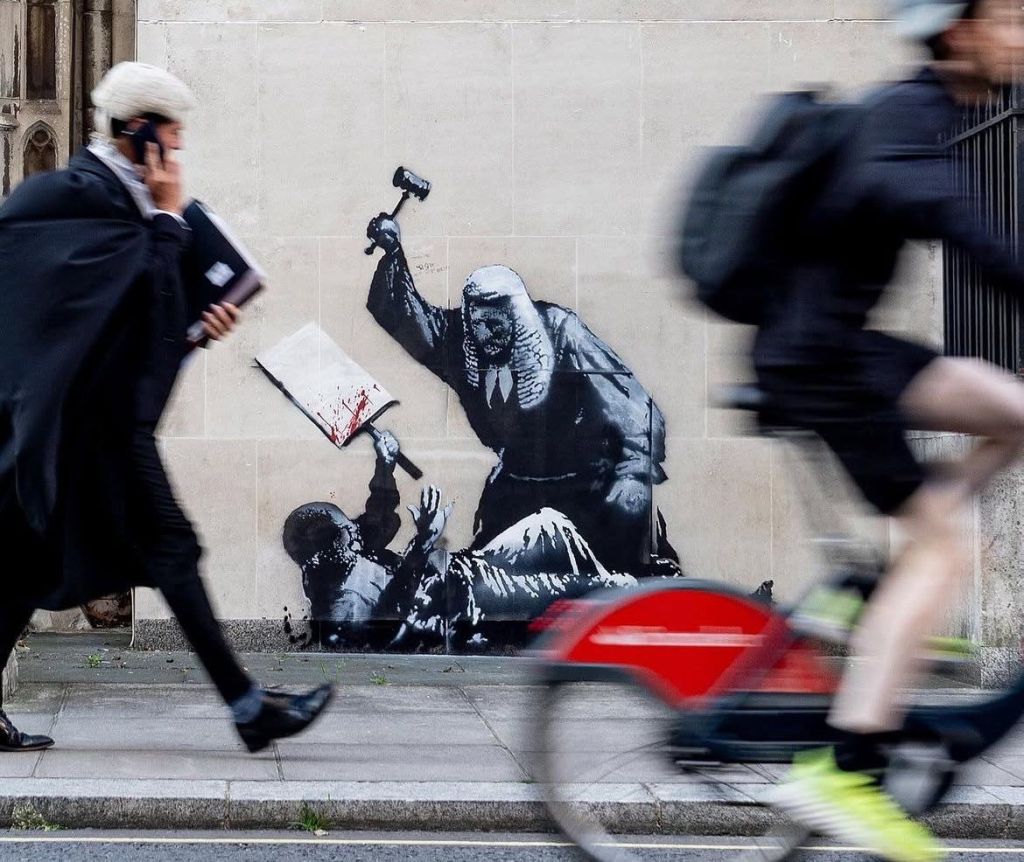
We now turn our eye to the other side of the Atlantic, to the United Kingdom. As Lord Mansfield indicates, law is one of the tools by which ordered liberty comes about. Liberty exercised under the law, sure, but not a law hawk-like piercing its talons into its prey. Yet, in Britain, where political consensus seems to be impossible to create, a large segment of the population of varying and disparate persuasions, has consensus on at least one thing. That is, on the fact that the State exercises a heavy-handedness in dealing with speech which is quite unbecoming of our country, the “Mother of the Free”.[21] The shrewdest of these observers, Banksy, made his protest by the now famous mural on the external walls of the Royal Courts of Justice. It would be asinine to complain about the removal of this statement on what are protected, historic buildings, whose historic character must be kept. Yet the mural itself speaks volumes. It speaks where the judiciary dare not speak. And here is where some of the woes of our polity are exposed.
For Baroness Herman commenting on Banksy’s act, and herself a former Justice Minster and practicing solicitor, to say, with the complacency of a positivist, that Parliament legislates and that “the judges simply interpret the law” (emphasis added) is notable.[22] She adds, and this is a red herring, that there is no evidence that the judiciary has “been clamping down on protests beyond what Parliament intended”.[23] A red herring, indeed, but itself revealing. Parliament, instrumentalised by the executive, and with the aid of an obedient judiciary have created an increasingly intolerable situation by which all manner of previously lawful speech has been rendered unlawful. The whole apparatus of the State, legislative, executive, including the police, and judicial, has been mobilised to mould public discourse in a manner inimical to free speech, and there is no indication, but rather the contrary, that this disturbing trend shall cease. How can the judiciary claim to have wholly clean hands when it is these very hands which give effect to this foolishness?
The Lady Chief Justice is right to rue the abuse judges are subjected to.[24] It is completely contrary to the spirit of a free people whose judiciary is part of the protection of that public safety which freedom, and prosperity require. But that does not place the judiciary out of the reach of criticism. Granted, the judiciary does not nowadays act in such a way as to go beyond what Parliament tells it to do. But it is, no matter how reluctantly, willing to stifle liberty when the legislature, steered by the executive, commands it so to do. That is itself censurable. The list of such action is simply too long to reproduce here, and readers will be familiar with examples in recent years, and this year also. The judges are human beings and citizens too, not mechanical instruments, and beyond their role of giving effect to law, they have a deeper obligation, as citizens and freemen, to defend our constitutional liberties. Why do they not speak out? Why do they acquiesce? A public declaration in the press by a judge, or even in sentencing remarks in an intolerable case, could have a significant impact in correcting policy, or at least making the public aware of what our country is sleepwalking into. Instead, we hear nothing. The judges continue, blind, mechanical, case by case, judgment by judgement, chipping away at freedoms until, sooner or later, they will open their eyes to see nothing left to chip away at.
I am reminded here of a satirical cartoon about the Banksy artwork made soon after it was unveiled.[25] You will remember that the artwork depicts a judge beating a bleeding protestor with a gavel. A judge and a barrister stand by the artwork, discussing it. The barrister says, ambiguously, or I suppose a little like Baroness Herman, “Well that’s not right”. The judge replies, “Quite. We never use gavels.” Indeed, it is this short-sightedness which affects Baroness Herman, for it is not so relevant that the judiciary is merely being faithful to Parliament. What is being protested is that in being so scrupulously faithful, our constitutional liberties are being upturned, and neither the legislature, nor the executive, nor even the judiciary can claim innocence; there is no defence for merely following orders, as she seems to suggest, where our very constitutional character as a nation is at stake. That they give effect to such laws is, perhaps, understandable, if annoying, but that they do not dare even question them outside court is utterly unacceptable.
It is deeply melancholy that we, Great Britain, the land from which all liberty springs, require reminding from the US Vice President that our government is undertaking a project of incrementally demolishing free speech.[26] It is deeply melancholy that a foreign statesman cares more about our native liberties, than our own Prime Minister, who slimily avoids questions about the British government’s gradual abolition of free speech, by simply affirming that he guards it “preciously”.[27] We ought to be doers, not hearers, or for that matter, speakers only, as Lord Bingham reminds us.[28] We ought to defend liberty, not merely extol it, whilst in fact undoing it. The shallow hypocrisy of not only the Prime Minister but many ministers past and present must be challenged by the electorate, or else we shall lose even what remains of our precious constitutional inheritance. At stake is a millennium of struggle and strife, of anguish and ambition, of aspirations for, and establishment of, liberty. We ought not to let it all come to nought. We ought to awaken, arise, and take the political action necessary, by writing to our elected representatives, by voting at the ballot box, and by peacefully protesting, so that our nation is not lost to us. It is our glory that we, of all peoples the longest, have representative government, so let us use our electoral power to preserve that liberty without which all forms of government are hollow.
It may seem that on one side of the Atlantic the American people, and on the other, the British people, are at a turning point in their history. In truth, they have been travelling to this point for many years now. What has happened this year, and what I suspect is going to happen, is the result of many millions of decisions by individuals, and by officials in government. First, the nature, quality, and style of our public discourse have undergone an extreme degeneration such that dehumanising rhetoric is commonplace. The lamentable results of this were seen in Utah recently. No democratic polity ought to reach such a point. Urgently, we need to instil anew in ourselves habits of tolerance, of patient listening, and genuinely attempting to understand our interlocutors; the costs of not doing so are dark. It is our duty as responsible citizens of free societies to cultivate these virtues, because we have the great responsibility of forming and holding accountable our governments. By our votes, we are responsible for the common good, and we must bear ourselves accordingly.
And so, in Britain we are required not only to do rediscover these virtues, which we are jointly tasked to do with the American people, but, I say, in Britain we have the special task of reestablishing our ancient liberties so wantonly trod upon by careless politicians concerned with only aggrandising their own power, to our detriment. It is in English, later British, soil that the oak of liberty first took firm root, and whence, upon the Mayflower, an acorn was taken to be planted in America. Today, the oak of American liberty is much healthier than its British progenitor. It is the task of every conscientious Briton to work to restore what we have lost and preserve what remains. The tools of democratic government are in our hands to achieve this, we need only show the will to use them.
I end with Burke, who well complements Lord Mansfield’s dictum, the basis of our discussion. “Freedom”, says Burke, is “not only reconcilable, but, as when well disciplined it is, auxiliary to law”.[29] When the laws are good, and the people upright and animated by a laudable public spiritedness, the condition of the State is secure. Liberty abounds, and tolerant discourse occurs in the public square. This is not an unattainable ideal. It is the reality which once was and which must again be reestablished for free government to endure, and for the torch of liberty to continue shining in our gloomy world.
[Note: I began writing this blog before the events I discuss later in it occurred. I included them and modified my plan for the blog accordingly, finding that they were topical and illustrative for the topic at hand. I hope the reader feels the same way.]
[1] Lord Neuberger, ‘A Scotsman Caught Young: The Influences Which Shaped William Murray, First Earl of Mansfield’ (The Selden Society, 22 October 2024) p. 15 <https://seldensociety.ac.uk/wp-content/uploads/2024/11/A-SCOTSMAN-CAUGHT-YOUNG-004.pdf> accessed 4 September 2025;
Lord Neuberger, ‘The UK Constitutional Settlement and the Role of the UK Supreme Court’ (Legal Wales Conference, 10 October 2014) [9] <https://uk-supremecourt.co.uk/uploads/speech_141010_665548d875.pdf> accessed 4 September 2025
[2] cf. Marbury v Madison, 5 U.S. 137 (1803) 168, where Marshall C.J. calls him “the very able judge”, citing him approvingly.
[3] See, for example, the celebrated case declaring that slavery is not lawful in England: Somerset v Stewart (1772) 20 How. St. Tr. 1. Lord Neuberger in his 2014 lecture, cited above, notes that Lord Mansfield invoked a form of the separation of powers before the formation of the U.S. Constitution in Proceedings against the Dean of St Asaph (1784) 4 Doug. 73, 170
[4] John Milton, Sonnet 12, vv. 11-12
[5] Proceedings against the Dean of St Asaph (1784) 4 Doug. 73, 170
[6] As though the Crowns were legally distinct, they were united is the person of the office-holder since the reign of James I, hence the illuminating phrase: tria juncta in uno. The union of the Crowns (that is, of the primary member of the executive departments in the person of the Chief Magistrate) temporally preceded the formal union of the realms by abolition of distinct legislatures, borders for trade purposes, and enactment of a completely unified foreign policy.
[7] Bill of Rights 1689, Preamble.
[8] I borrow this phrase of great significance, and, over time, greatly modified signification, from the currently enacted statutory version of Magna Carta (1297), Art. 1. The notion of Englishmen as “freemen” under law seems to have influenced the complaints in the Declaration of Independence (1776).
[9] Hansard, HC Deb. 20 July 1988 vol 137 c1081 (Revolutions of 1688–89 (Tercentenary))
[10] (Licentious, n., Samuel Johnson’s Dictionary, 2nd edn (1792)) <https://johnsonsdictionaryonline.com/views/search.php?term=licentious> accessed 9 September 2025
[11] I have in mind the example Johnson, ibid, quotes from the Earl of Roscommon’s poems:
“The Tyber, whose licentious waves,
So often overflow’d the neighbouring fields,
Now runs a smooth and inoffensive course” (emphasis in original).
[12] Edmund Burke, The Works of the Right Honourable Edmund Burke (vol. 3, John C. Nimmo 1887) 559
[13] Ibid 242
[14] So, Aristotle famously argues that whilst each individual person in the polity might not be excellent, the aggregate of their qualities (and views) may surpass the judgment of a single individual, and, they being coordinated may act, in the political state, “like a single person”. Thus, a powerful defence for republican democratic government is provided to us in the pages of that ancient philosopher. See Aristotle, Politics (trans. Ernst Barker and R.F. Stalley, OUP 1995) 108-109
[15] ‘US Ambassador to UK urges for ‘political rhetoric be dialled down’ following Charlie Kirk killing’ (sic.) <https://www.gbnews.com/news/charlie-kirk-us-ambassador-political-rhetoric-dialed-down> (GB News, 11 September 2025) accessed 12 September 2025
[16] ibid
[17] ‘Cardinal Parolin on Charlie Kirk death: ‘We are against all types of violence’’ <https://www.catholicnewsagency.com/news/266503/vatican-secretary-of-state-cardinal-parolin-on-charlie-kirk-death-we-are-against-all-types-of-violence> accessed 12 September 2025
[18] Abrams v. United States, 250 U.S. 616 (1919) 630 (Holmes J., dissenting).
[19] cf. Dobbs v. Jackson Women’s Health Organization 597 _____ U.S. (2019) 217
[20] Benjamin Franklin, letter to the Abbés Chalut and Arnoux (April 17th 1787)
[21] A.C. Benson (lyrics), ‘Land of Hope and Glory’, v. 1
[22] ‘Banksy artwork to be removed from Royal Courts of Justice’ (Press Association, 8 September 2025) <https://pa.media/blogs/pa-editors-picks/banksy-artwork-to-be-removed-from-royal-courts-of-justice/> accessed 12 September 2025
[23] ibid
[24] Baroness Carr of Walton-on-the-Hill, ‘Mansion House speech by the Lady Chief Justice’ (2 July 2025) <https://www.judiciary.uk/mansion-house-speech-by-the-lady-chief-justice-2/> accessed 12 September 2025
[25] In the Metro Newspaper (10 September 2025) p. 4
[26] ‘JD Vance warns against UK going down ‘dark path’ of losing free speech during meeting with David Lammy’ (Sky News, 8 August 2025) <https://news.sky.com/story/jd-vance-warns-against-uk-going-down-dark-path-of-losing-free-speech-during-meeting-with-david-lammy-13408626> accessed 12 September 2025
[27] If Kier Starmer thinks his, and previous governments, have guarded free speech “preciously”, then it ought to worry us all very much how they would treat something they consider to be trivial! He cannot but be speaking hypocritically. See: ‘Prime Minister says UK guards free speech ‘preciously’ after Vance criticism’ (The Independent, 26 February 2025) <https://www.independent.co.uk/news/uk/home-news/jd-vance-keir-starmer-prime-minister-fox-news-munich-b2706200.html> accessed 12 September 2025
[28] Lord Bingham, The Rule of Law (Penguin Books 2010) 173, quoting James 1:22 (KJV)
[29] Edmund Burke, op. cit., 279
 The Legal Microscope
Leave a comment