In this second part of my discussion of the term “Proceedings in Parliament” in Article 9 of the Bill of Rights, I resume my discussion concluding the discussion of the case-law begun in part 1.
- R (on the application of Miller) v The Prime Minister [2019] UKSC 41
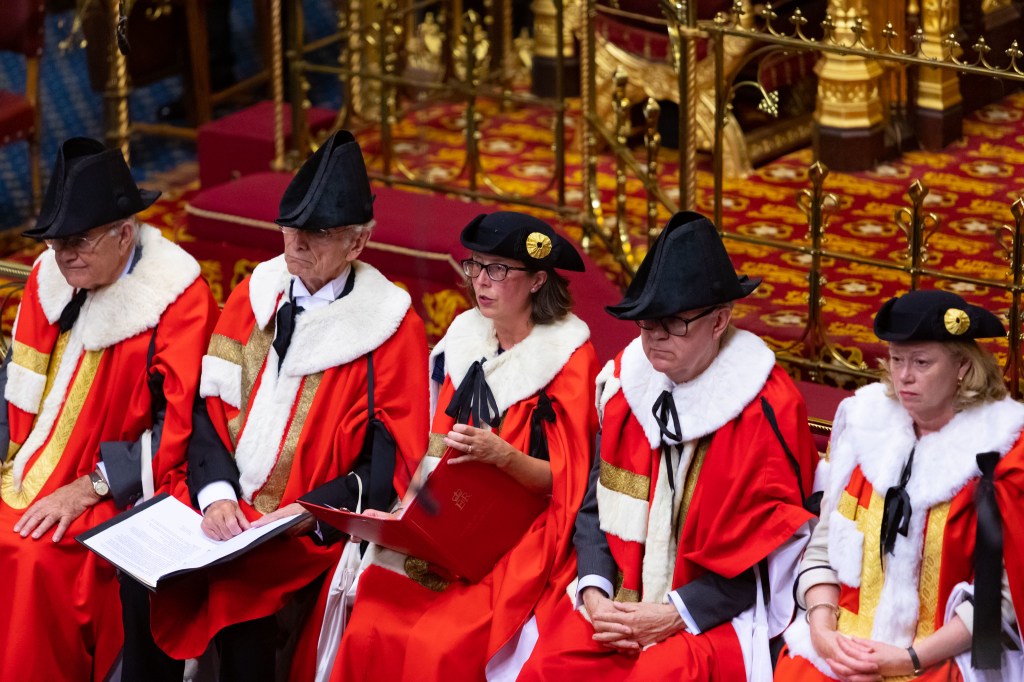
Donning long crimson, ermine-lined robes and cocked hats, sat below the glimmering golden throne with all Parliament assembled before them, the Royal Commission prorogues the legislature in the name of the Crown. A scene of trivial importance in other years, perhaps even a quaint reminder of centuries past when the King held the power, and not only the splendour, of imperial majesty. However, in 2019 many MPs felt that the prorogation was not the ordinary, comfortable affair done every year prior, but rather a usurpation by the Crown, a Stuart deed looking backwards to the days before the Glorious Revolution and its Bill of Rights. An act, that is, depriving Parliament of its voice amid a most controversial constitutional reconstruction. Paul Craig, at least, thought that when defending the prorogation judgment, accusing its critics of espousing a defunct Stuart form of government. At any rate, it was the Crown which attempted to rely on Article 9 of the Bill before the Supreme Court to prevent judicial inquiry into the prorogation. So, does its argument hold up? And what is the relation of the prorogation case to the prior precedent on the question?
The Crown argued, simply, that prorogation was a “Proceeding in Parliament” and was therefore excluded from judicial review. The Court disagreed, holding that prorogation was not part of the essential business of Parliament which consists in legislation and debate.[1] In holding this, it relied on Chaytor.[2]
So, what to make of this holding? I think that the judgement of the court, at least in so far as it concerned Article 9, was wrong for two reasons. First, it misapplied the case-law. Second, and relatedly, it misconstrued the nature of a proceeding in Parliament and the relation, as envisioned by the Bill of Rights, of that with judicial proceedings. These reasons, as I hope will become apparent in what follows, are closely linked and that discussion of one flows into discussion of the other. I will preface this by saying that the underlying the Court’s misunderstanding is a manifestly false conception of the nature of Parliament made clear by such strange argumentation which seems to suggest that the Crown is somehow an external agent imposing its will on Parliament,[3] instead of the Crown being, in its nature, a part of Parliament. Indeed, this misunderstanding leads to a false view of the relationship between law and politics in the management of the constitution in our polity.
Let’s start with the case-law. As I said, the Court sought to rely on its earlier precedent in Chaytor as to the meaning of proceedings in Parliament. I need not rehearse here my analysis of Chaytor. It will however serve us well to see how the Court used that case in the context of prorogation. You will remember that in Chaytor, Lord Phillips held for the Court that a proceeding in Parliament concerned the essential business of Parliament, among which activities were included debates and the freedom of speech of parliamentarians.[4] In his Lordships words, proceedings in Parliament are the “core or essential business of Parliament, which consists of collective deliberation and decision making”.[5] The prorogation judgment however held that since prorogation was not a decision of either the Commons or the Lords it was not a proceeding in that sense (ignoring that it was a decision of the Crown, itself a part of Parliament). Nor, said the Court, did it concern the freedom of speech or debate in Parliament. Nor were the Commissioners acting as parliamentarians, and thus exercising their freedom of speech, in the prorogation proceedings but rather they were agents of the extrinsic Crown.[6] This holding does not stand up to the slightest scrutiny.
Quite simply, the Court tried to push the precedent in Chaytor too far.[7] It tried to pump a well long after it was dry. It did this first as to the nature of proceedings and next as to whether prorogation falls into Parliaments exclusive cognizance.
Chaytor itself endorsed the view that the term we are concerned with had no “comprehensive” definition.[8] Thus the term is to be defined piecemeal, case by case. The broadest proposition which Chaytor is authority for is that debates and the freedom of speech are part of proceedings in Parliament, but not that proceedings in Parliament is exclusive of them. In its nature, it excluded prorogation on its facts, but in its legal holding rather supported prorogation. For, as we have seen in part 1, the orthodox position ever since Blackstone is that the King himself has freedom of speech in parliament as a constituent part of it. So what if it is exercised through the Commissioners? It is still the King who speaks before his assembled Commons and Lords in managing the legislature. The prorogation Court’s holding, seemingly excluding the King as a part of Parliament is strange. It is doubly strange in throwing up the red herring of the Commissioners not exercising their own freedom of speech, for it is not they who are speaking but the Crown.
But does prorogation bring “the core or essential business of Parliament to an end”?[9] It cannot because it, in the Crowns exercise of the freedom of speech, and in Parliament’s self-management (because the Crown is part of it) is itself an exercise of the core or essential business of Parliament. It is not necessary to the nature of Parliament to go on legislating forever.[10] Indeed, the management of parliamentary time in prorogation whether for political purposes (as with Clement Attlee in 1948 or Boris Johnson in 2019) or not has always been done. Prorogation, in my view then, is a proceeding in Parliament as an exercise of the Crown’s inherent authority as a part of Parliament, and as an exercise of the Crown’s free speech in Parliament.
Article 9 was enacted in the context of a political revolution, and was part of a legal remedy, namely the Bill of Rights, creating a political settlement for power to be exercised more in accord with the traditional rights and liberties of the English people. Lest I be accused of using rhetorical flourishes to stop up a leaking barrel of an argument, just consider what Article 9 does. Consider the text of the Article again: “[…] Proceedings in Parlyament ought not to be impeached or questioned in any Court or Place out of Parlyament”. Clearly then, what I say is true. For Parliament reserves to itself, which is to say either in its collective capacity or in the individual powers of each of its parts as it has sought fit to allocate or maintain such powers, the right to make decisions about internal proceedings. t is to its exclusive cognizance and decision-making, excluding judicial consideration, all proceedings. This, in fact, is exactly what we saw in 2019. Parliament, in passing the last minute Benn Act implicitly chose not to maximise its opportunities to legislate but acquiesced in the prorogation.[11]
The government invoked a relevant precedent in the legal proceedings, which the Supreme Court decided to ignore. I am inclined to think that because the precedent tended to disprove the Court’s claims is why it was ignored. This was the Barclay case I discussed in part 1.[12] In its submissions to the Court, the government argued thus:
“In R (Barclay) v Lord Chancellor [2014/5]… the Supreme Court unanimously held that the granting of Royal Assent was a proceeding in Parliament. That is significant because Royal Assent may be granted by Commission, including by the same commission which provides for the prorogation of Parliament. Per Baroness Hale of Richmond at §48: “Nor is the analogy [of assent to Laws passed by the Chief Pleas of the Island of Sark] with Royal Assent to Acts of the United Kingdom Parliament exact: the Queen in Parliament is sovereign and its procedures cannot be questioned in the courts of the United Kingdom.”[13]
Our discussion of that precedents and the government’s own argument tend to prove the argument against the Court’s holding in the prorogation case. First, it is the Crown exercising its freedom of speech in Parliament, irrespective of the individual members of the Commission, which is in question. This freedom is unimpeachable. Second, the Crown has the right to exercise those of its prerogatives which as unimpeachable through its Commissioners. This is a view upheld in the Barclay precedent, and there are no grounds to distinguish it from prorogation.
Indeed, the reasoning in the prorogation case inasmuch as it treats the Crown as a foreign element to Parliament is grounds for removing even the prerogative of Assent from being protected by Article 9. Relatedly, Anne Twomey observes that on the basis of the prorogation case, if ministers who have lost the confidence of Parliament advise the Crown to refuse Assent, such an action may be declared null and of no effect.[14] Plainly then, the Miller (II) precedent takes a judicializing view of the constitution. Their Lordships in the Supreme Court are entitled to this view and to advocate for it as citizens. But as judges? No, for them to have done so is to have, as we have observed, nullified the plain meaning and intent of the Bill of Rights. Article 9 intended to protect the complex series of conventions, rules and practices, all political, which have traditionally protected liberty and good government in our constitution. If I may end with a quote from John Finnis, which summarizes my view of Article 9 which I have argued in this series,
“The Crown is an integral part of Parliament. Its assent is indispensable for the very existence of an Act. Its consent, signified by one of the Queen’s ministers, is constitutionally required for certain Bills even to be debated, though this constitutional rule, like others closely related to it, is not justiciable in the courts – a non-justiciability established by reason of that complex of rules, principles and conventions, a complex of which art. 9 of the Bill of Rights is a plain manifestation and enforcer. The Crown’s actions in Parliament are proceedings in Parliament”.[15]
[1] R (on the application of Miller) v The Prime Minister [2019] UKSC 41 [65]-[66]
[2] cf. R v Chaytor [2010] UKSC 52
[3] Miller (II) (n1) [68]: “It is not a decision of either House of Parliament. Quite the contrary: it is something which is imposed upon them from outside.”
[4] Chaytor (n2) [62]
[5] ibid
[6] Miller (II) (n1) [68]
[7] Ibid [66]
[8] Joint Committee on Parliamentary Privilege Report [1999] HL 43-1;HC214-1 in Chaylor (n2) [54]
[9] Miller (II) (n2) [68]
[10] Cf. Richard Ekins, ‘The Supreme Court’s prorogation judgment and its constitutional implications’ (HC PIS 0001, October 2019) [12] <https://committees.parliament.uk/writtenevidence/105645/html/> accessed 11th November 2025
[11] cf. Timothy Endicott, ‘Making Constitutional Principles into Laws’ [2020] LQR 175, 181; European Union (Withdrawal) (No. 2) Act 2019
[12] R (Sir David Barclay) v Lord Chancellor [2014] UKSC 54
[13] Quoted in John Finnis, The unconstitutionality of the Supreme Court’s prorogation judgment (2019, Policy Exchange) 8, para. [5]
[14] Anne Twomey, ‘Article 9, parliamentary proceedings and the consequences of Miller (No 2)’ <https://judicialpowerproject.org.uk/anne-twomey-article-9-parliamentary-proceedings-and-the-consequences-of-miller-no-2/> accessed 12th November 2025
[15] John Finnis (n13) [4]
 The Legal Microscope
Leave a comment